Ringbauer et al. argued in their 2025 paper, “Punic people were genetically diverse with almost no Levantine ancestors”, that Punic people had almost no Levantine ancestors. Their conclusion seems to be based mainly on qpAdm rotation results. Instead of testing each sample against a stable set of ancestry-anchoring right groups, they rotated potential sources between the left and right groups.
The source choices were distal. Instead of using Iron Age groups from around the Mediterranean, including the newly sequenced Akhziv Phoenician group, the study used Bronze Age groups. It also used Neolithic Ganj Dareh as a source.
The ADMIXTURE run did not give meaningful results as they stated themselves. Given the low coverage of these ancient samples, ADMIXTURE does not seem to be the best choice here, even leaving aside how meaningful its inferred components usually are.
The PCA-based ancestry estimate is also questionable, since it treats a sample’s position along a Sicily Bronze Age to North Africa cline as a direct ancestry proportion, at least as I understand their method.
I modeled the Punic samples using F4Mix with a set of Iron Age Mediterranean reference populations, including the Phoenicians from Akhziv. Substantial Phoenician-like ancestry appears across several groups:
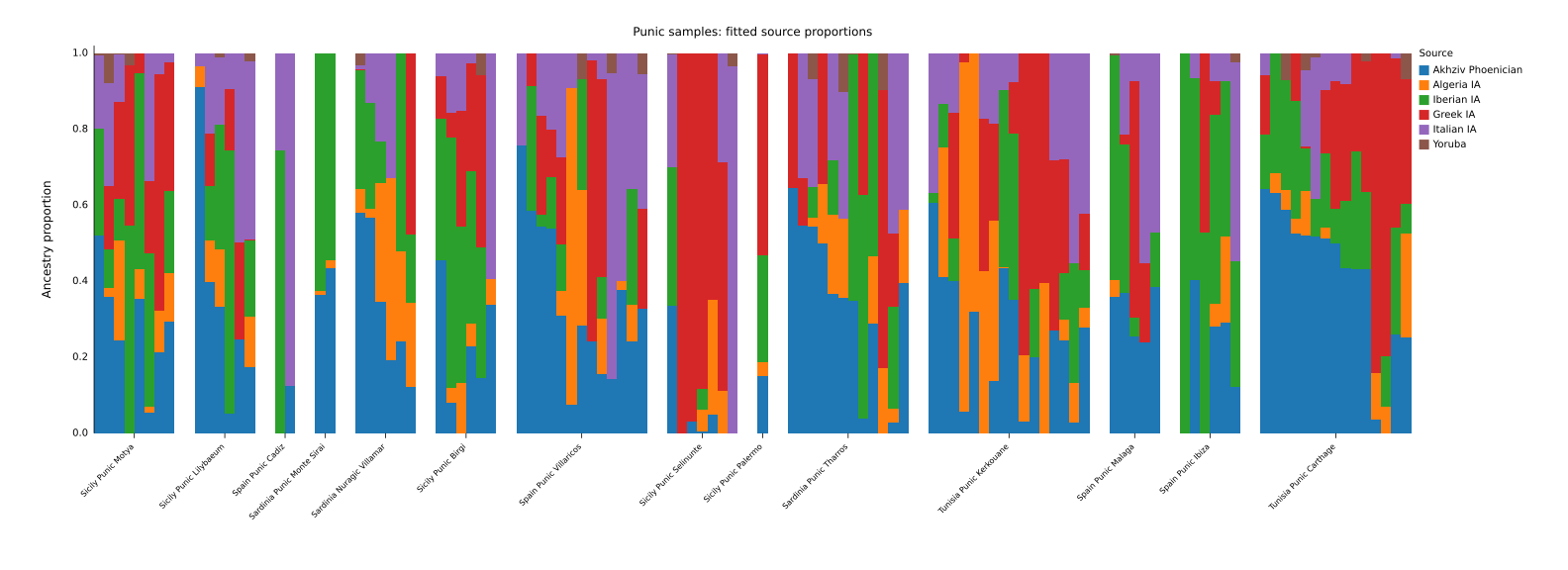
Most notably, most Carthage samples score substantial Phoenician-like ancestry here (41.9% Akhziv on average), compared with only one sample in the study’s Carthago models. As a separate plausibility check, several Selinunte samples score Iron Age Greek ancestry. Selinunte was founded as a Greek colony.
These models might not be perfect, and F4Mix does not provide a formal fit test here. However, most of the studies tested qpAdm source combinations were rejected, and ADMIXTURE does not test model fit either. The F4Mix results are generally coherent, although some samples have noticeably worse chi-squared values, particularly both Cádiz samples, as well as individual samples from Tharros and Lilybaeum.