Among the unreleased samples in the Akbari et al. dataset is an individual (IID: I25719) rumoured to be from Kish, dated in the supplementary table to the Early Dynastic III period, around 2450 BCE. His Y-DNA haplogroup is G-FT19860, a downstream branch of G2a, one of the main paternal lineages associated with Anatolian Neolithic farmers, and his mtDNA haplogroup is R0a1a.
The sample has decent coverage: 598,059 “compatibility” SNPs were called (48.09%), 645,472 were missing.
This makes the individual the first Sumerian aDNA sample till date whose language is considered a language isolate by linguists.
A two-source qpAdm model for sample I25719 results in 71.4 ± 5.3% Nevalı Çori PPN-related ancestry and 28.6 ± 5.3% Ganj Dareh Neolithic-related ancestry, with a very good model fit (p = 0.753).
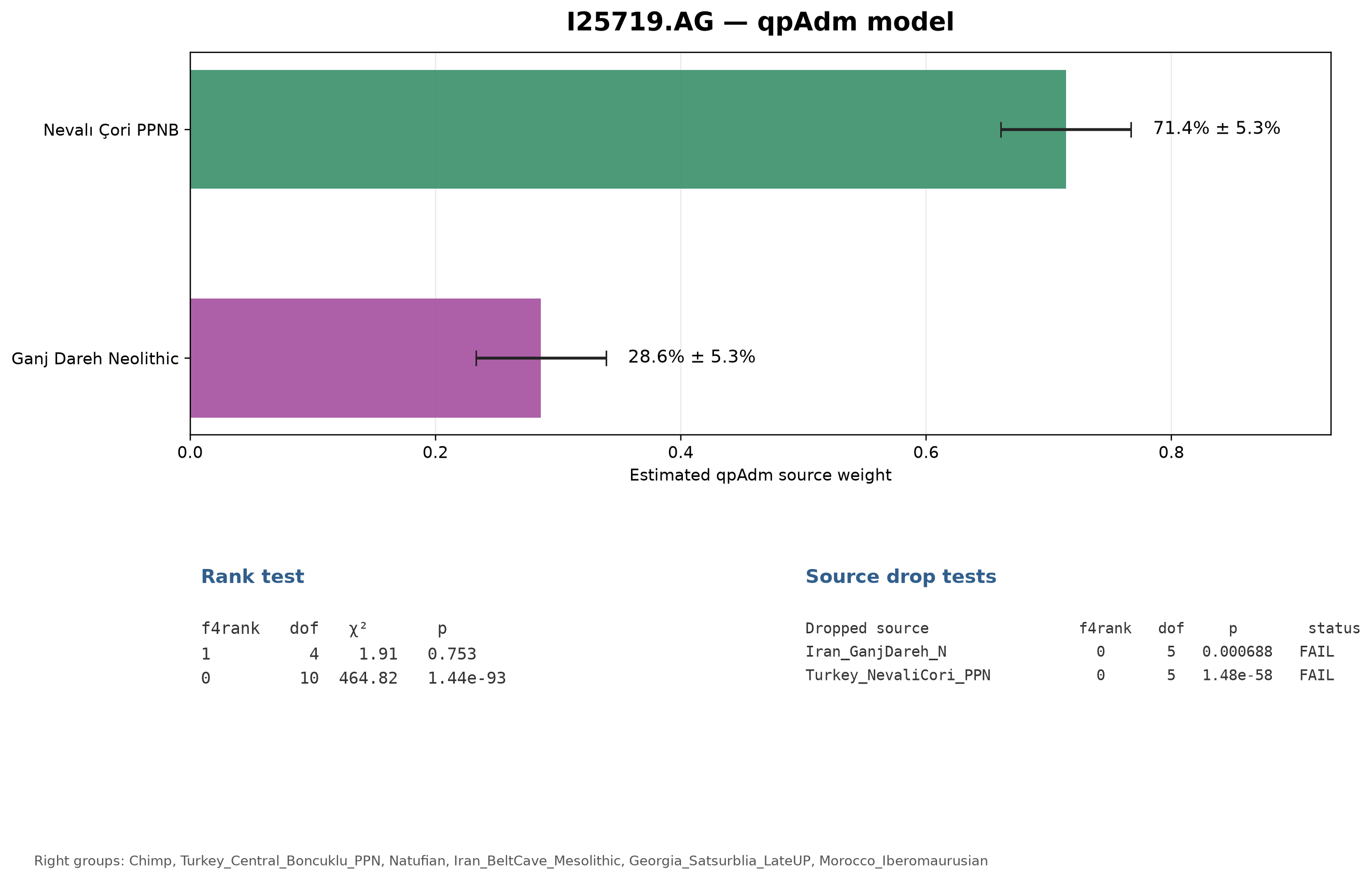
Replacing Nevalı Çori with Çayönü still gives a good-fitting model, although the Zagros Neolithic-related contribution becomes less significant. A single-source Çayönü model also passes borderline in this right-group setup, with a p-value of about 0.07. I would not put too much weight on that, however, adding a few more right groups could make the model fail.
These results strongly suggest that this potential Sumerian sample ultimately derived most of his ancestry from Nevalı Çori-like Neolithic populations. This continuity could be mediated through still-unsampled Chalcolithic populations from the southern Mesopotamian region.
I also compared I25719 directly with Nevalı Çori, by calculating a series of statistics across relevant reference populations:
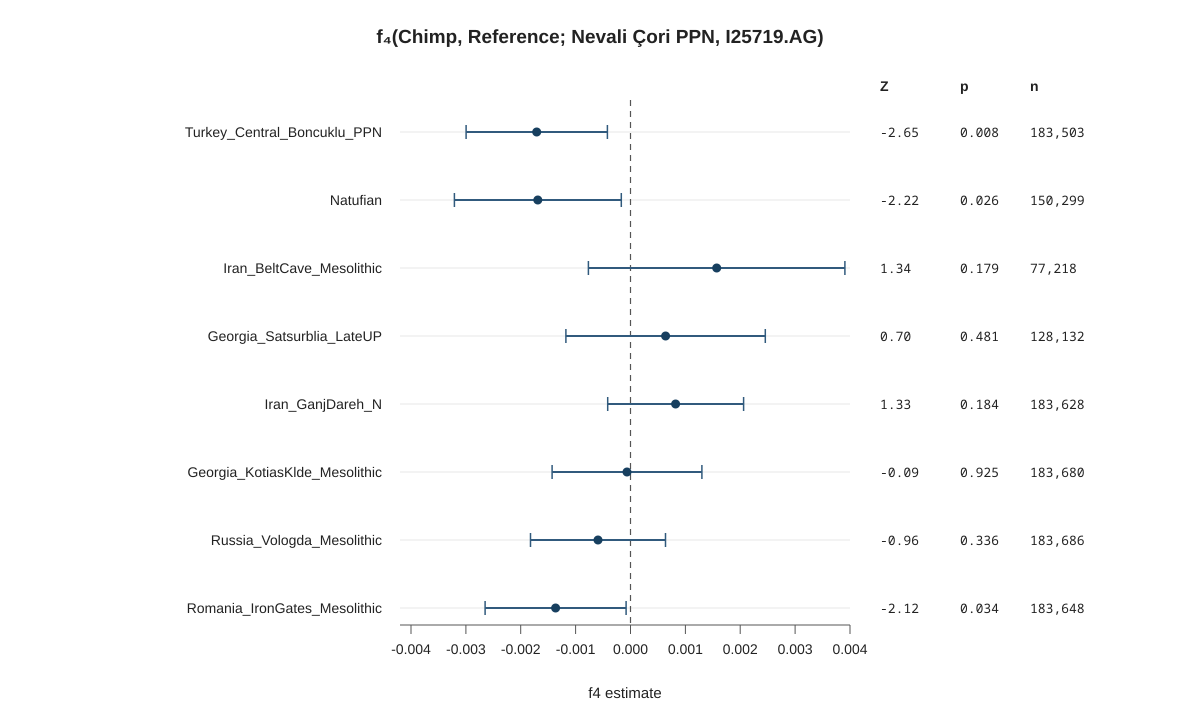
Positive values indicate excess affinity of I25719 to the reference population, while negative values indicate excess affinity of Nevalı Çori. The overall pattern is consistent with the qpAdm model, with I25719 remaining close to Nevalı Çori overall, while Nevalı Çori shows a greater western Anatolian affinity and I25719 a slight shift toward the eastern Fertile Crescent. The deviations are even smaller when Çayönü is used as the comparison population, although, as stated above, the qpAdm decomposition is weaker.
Note: In f4-based compatibility rankings, I25719 shows rather low differentiation from neighboring Mesopotamian groups, especially the Nemrik 9 Middle Assyrian-period individual (I6441, northern Iraq, ~1350 BCE), followed by the early Tylos individual from Bahrain (AS_EMT). Kish had a substantial East Semitic presence during the Early Dynastic period, so whether this individual was specifically Sumerian cannot be definitely established without archaeological context. At the same time, I would not expect core Sumerian-speaking populations to have been genetically very different from the genetic profile of this sample.